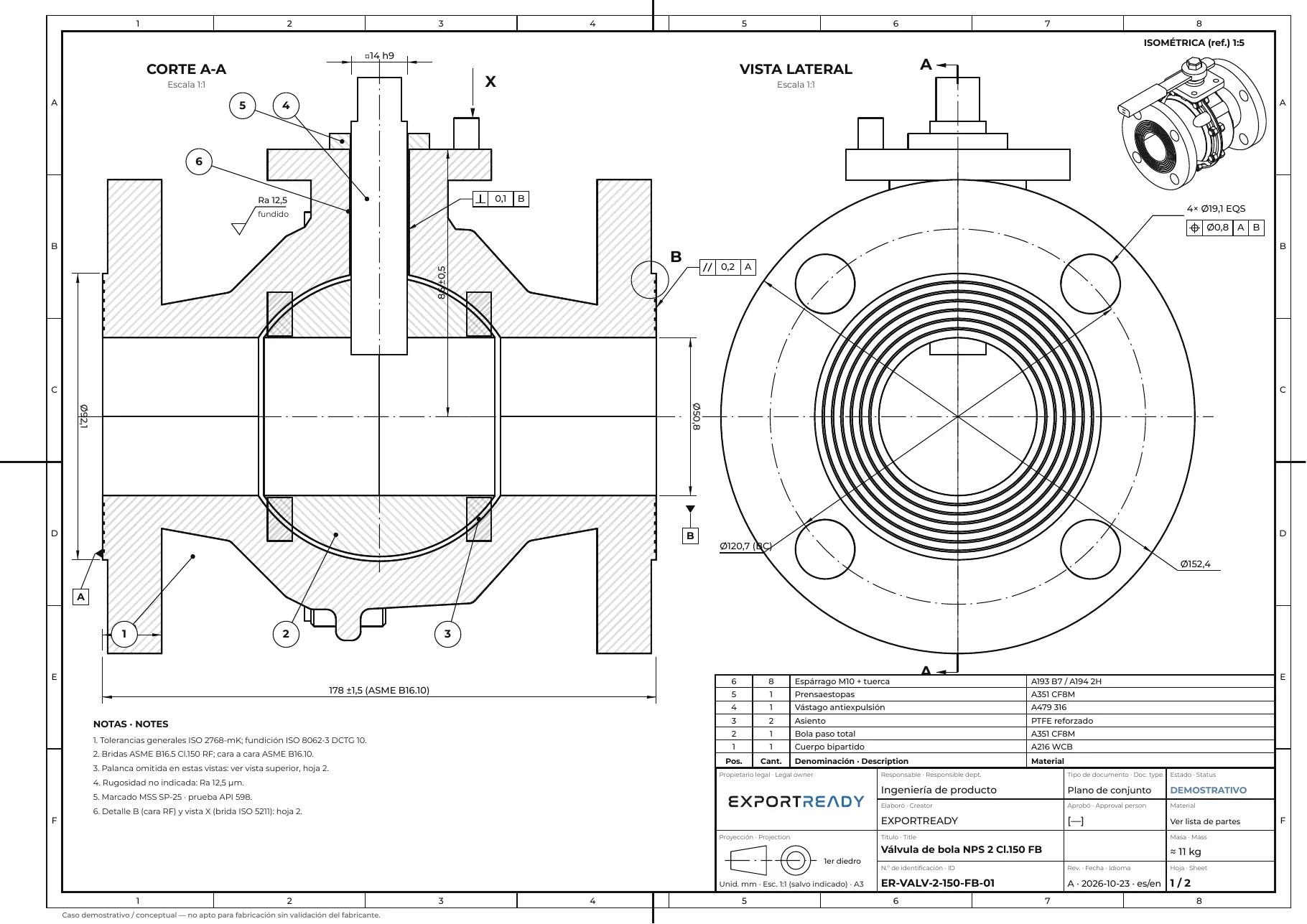
1. A dimensioned drawing in units the buyer uses
Your buyer installs the equipment in a plant that works in inches and pounds. A metric-only drawing raises questions and slows the quote. The practical approach is dual dimensioning (mm [in]) for installation dimensions, connections and weights, stating the standard for each connection: ASME B16.5 flanges, NPT threads and so on.
2. A one-page datasheet
This is what the distributor uploads to its catalog. It should summarize model, overall dimensions, materials, operating ranges (pressure, temperature, power), weight and connections. If the datasheet and the drawing disagree, the buyer will notice.
3. An installation, operation and maintenance manual in English
An English manual is almost always required by industrial buyers. For safety messages, the usual US reference is ANSI Z535.6, which defines the DANGER, WARNING and CAUTION signal words and how each message is structured. For labels on the product itself, the reference is ANSI Z535.4.
For machinery, the buyer may also ask that the design follow the ANSI B11 series or, for the machine’s electrical equipment, NFPA 79.
4. Certification of electrical equipment
If your product has electrical components and will be used in a workplace, the buyer will almost always ask for certification by an OSHA-recognized laboratory (NRTL) such as UL, CSA or Intertek. The lab issues the certification; what you prepare is the file: drawings, component list, instructions and markings.
5. Country-of-origin marking and nameplate
Imported goods must show their country of origin legibly and permanently (19 CFR Part 134). It pays to define, in a marking drawing, where the nameplate goes, what it says and where the safety labels are placed.
Quick checklist
- Dimensioned drawing in mm [in] with connection standards
- One-page datasheet in English
- English IOM manual with ANSI Z535.6 safety messages
- Product labels per ANSI Z535.4
- NRTL certification if there are electrical components
- Nameplate and country-of-origin marking
Shipping your product to the US? We help you build the technical file per product family.
Get a quote on WhatsAppFrequently asked questions
Do I need UL to export to the US?
Not for every product. It is common for electrical equipment used in workplaces, where OSHA requires approved equipment and buyers ask for NRTL certification. It usually does not apply to products without electrical components.
Can the manual be English only?
For the US buyer, yes. If you also sell in Mexico or Latin America, keep a Spanish version with the same structure.
References: ANSI Z535.4 and Z535.6; OSHA NRTL program; 19 CFR Part 134 (country-of-origin marking); NFPA 79. This article is for guidance only and does not replace advice from a customs broker or certification lab.